How to Become an EMT in Los Angeles: A Complete Guide
Becoming a certified Emergency Medical Technician in Los Angeles requires completing a California EMSA-approved training program, passing the National Registry of Emergency Medical Technicians (NREMT) exam, and obtaining EMT certification through the LA County EMS Agency. The entire process can typically be completed in three to six months, depending on your training program and exam scheduling.
At U.S. Colleges, we offer EMT training programs in as few as 8 weeks at our Montclair, Santa Ana, and San Diego campuses. This guide walks through every step of the process, from meeting prerequisites through maintaining your certification and planning what comes next.
What California and LA County Require for EMT Certification
Phlebotomy technicians work in diverse healthcare settings. Graduates can work in a clinical laboratory, hospital, clinic, or a physician’s office setting. Additional employment settings include:
- At least 18 years old
- High school diploma or GED
- Current CPR/BLS certification (American Heart Association or American Red Cross in-person course; LA County does not accept online-only CPR cards)s
- Completion of an EMSA-approved EMT training program
- Social Security Number
- DOJ and FBI Live Scan fingerprint background check
One important LA County distinction: unlike paramedics, EMTs do not need a separate county accreditation process. The LA County EMS Agency confirms that a valid California EMT certification plus a current CPR card is sufficient to work in LA County. Also worth noting: Advanced EMT (AEMT) is not a recognized designation in Los Angeles County. EMTs looking to advance must pursue full paramedic certification.
Step-by-Step: From Enrollment to Certified EMT
Step 1: Obtain Your CPR/BLS Certification
Before enrolling in an EMT program, secure a valid CPR/BLS card from the American Heart Association or American Red Cross. LA County requires the card to remain valid for at least three months beyond your certification application date, so plan your timing accordingly.
Step 2: Complete an EMSA-Approved EMT Training Program
California requires a minimum of approximately 160 hours of EMT training, including at least 136 to 146 hours of classroom instruction and skills lab work, plus 24 hours of supervised clinical experience with a minimum of 10 documented patient contacts.
The curriculum covers:
- Patient assessment and management
- Trauma care and bleeding control
- Airway management and respiratory emergencies
- Cardiac emergency recognition
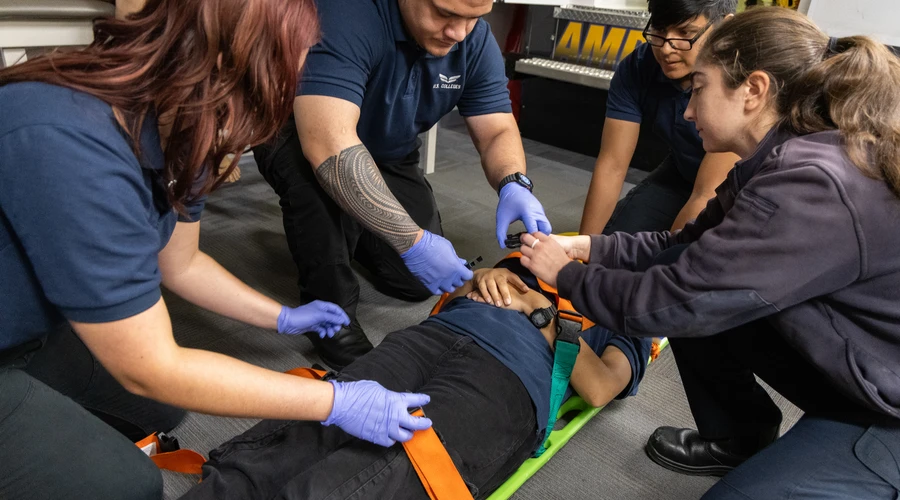
- Fracture immobilization and spinal care
- EMS operations and scene safety
- Medical terminology and pharmacology basics
Program formats range from intensive accelerated courses to semester-length programs. At U.S. Colleges, our EMT program runs 154 hours of classroom instruction plus 24 hours of ride-along clinical observation, and can be completed in as few as 8 weeks. Course completion records remain valid for two years.
Step 3: Pass the NREMT Examinations
California requires all first-time EMT applicants to pass both the NREMT cognitive exam and the psychomotor (skills) exam. The cognitive exam uses a Computer Adaptive Test (CAT) format, presenting between 70 and 120 questions within a two-hour window. The exam costs $104 per attempt and is administered at Pearson VUE testing centers or via online proctoring.
The current content breakdown reflects the 2025 NREMT update:
| Content Domain | Percentage of Exam |
| Scene Size-Up and Safety | 15%–19% |
| Primary Assessment | 39%–43% |
| Secondary Assessment | 5%–9% |
| Patient Treatment and Transport | 20%–24% |
| Operations | 9%–13% |
The passing threshold is a score of 950 on the 100–1,500 scale. Candidates who don’t pass must wait 15 days between attempts and have six total attempts, with remedial education required after three failures. The Authorization to Test (ATT) is valid for 90 days once issued.
The psychomotor exam is administered separately by your training program or a state-approved testing site.
Step 4: Complete the Live Scan Background Check
Using the LA County EMS Agency’s specific Live Scan Request Form, visit a California Department of Justice-approved location to submit your fingerprints electronically. Results typically arrive within seven days, though some cases take longer. State law prohibits transferring Live Scan results between agencies, so an existing scan from another entity cannot be reused.
Step 5: Apply for LA County EMT Certification
Submit your completed application to the LA County EMS Agency with a $190 fee. Required documents include:
- NREMT EMT card
- Course completion record
- CPR card (front and back, with barcode)
- Government-issued photo ID
- Live Scan form
Applications can be submitted by mail or in person. Processing takes up to 21 business days, and the agency does not offer expedited service.
How Long Does It Take to Become an EMT in Los Angeles?
The timeline varies depending on the program format you choose.
| Program Format | Training Duration | Total Timeline (Estimated) |
| Accelerated (4–8 weeks) | 4–8 weeks | 3–4 months total |
| Hybrid or semester | 10–16 weeks | 4–6 months total |
| Community college semester | 16–18 weeks | 5–6 months total |
The training portion is typically the longest phase. Exam scheduling, Live Scan processing, and LA County application review each add time on top of that.
At U.S. Colleges, the program can be completed in as few as 8 weeks, which is one of the faster paths available in Southern California. New classes start frequently, so you can begin training when you’re ready rather than waiting for a semester to open up.
What You’ll Learn in EMT Training
EMT training prepares you to provide pre-hospital emergency care: the critical stabilization and transport that happens before a patient reaches a hospital. The skills you’ll develop include:
Emergency response skills:
- Basic life support (BLS) procedures
- CPR and automated defibrillator use
- Airway management
- Bleeding control and shock management
- Spinal immobilization and patient stabilization
- Fracture care and splinting
- Emergency childbirth assistance
Assessment and documentation:
- Patient assessment in emergency settings
- Vital signs and their significance
- Medical terminology for EMS
- Documentation and reporting requirements
Professional development:
- Scene safety and situational awareness
- Communication with patients, families, and hospital staff
- Working under pressure
- Ethics and professional conduct in emergency services
The 24-hour ride-along component is particularly valuable. You’ll observe real emergency calls alongside working EMTs, which gives you a clear picture of what the job actually involves before you start applying for positions.
Cost Breakdown: What to Budget For
| Expense | Estimated Cost |
| CPR/BLS certification | $30–$80 |
| EMT training program | Varies by provider |
| NREMT cognitive exam | $104 per attempt |
| Live Scan background check | ~$80 |
| LA County initial certification | $190 |
Contact your training program directly for current tuition information. Financial assistance may be available for those who qualify through workforce development programs like WIOA, employer sponsorship, or payment plans.
Career Paths After EMT Certification
EMT-Basic certification opens several directions within emergency medicine and broader healthcare. In Los Angeles County, the advancement path runs directly from EMT to paramedic, since AEMT is not a recognized designation in Los Angeles County.
- Paramedic certification: Requires approximately 1,200 to 1,800 hours of additional training, typically through a community college associate’s degree program over 12 to 18 months. Paramedics have a significantly expanded scope of practice, including intubation, IV therapy, EKG interpretation, and a wider range of medications.
- Paramedic certification: Requires approximately 1,200 to 1,800 hours of additional training, typically through a community college associate’s degree program over 12 to 18 months. Paramedics have a significantly expanded scope of practice, including intubation, IV therapy, EKG interpretation, and a wider range of medications.
- Hospital ER technician: Some EMTs transition to emergency room support roles within hospital settings.
- Event and industrial EMS: Special events, film productions, industrial sites, and other venues hire EMTs for on-site coverage.
- Flight paramedic: Requires several years of ground experience post-paramedic certification, plus a Flight Paramedic-Certified (FP-C) credential.
Renewing Your California EMT Certification
EMT certification in California is valid statewide for two years. To renew, you’ll need:
- 24 hours of EMS continuing education
- A Skills Competency Verification form
- Documentation of training in naloxone, epinephrine auto-injector, and glucometer use
California does not require ongoing NREMT maintenance for renewal. LA County renewal fees are $149 if you stay with the same certifying entity, or $190 if you switch to a different agency.
Frequently Asked Questions
Does LA County require separate EMT accreditation?
No. Unlike paramedics, EMTs in Los Angeles County do not need a separate county accreditation. A valid California EMT certification and a current CPR card are sufficient to work in LA County.
Can I use an online-only CPR course for EMT certification in LA County?
No. LA County explicitly requires in-person CPR/BLS certification from the American Heart Association or American Red Cross. Online-only courses are not accepted.
How many attempts do I get on the NREMT exam?
Six total attempts. Candidates must wait 15 days between attempts, and remedial education is required after three failures. The ATT is valid for 90 days from the date it’s issued.
Is AEMT certification available in Los Angeles?
No. Los Angeles County does not recognize the Advanced EMT (AEMT) designation. EMTs in LA County advance directly from EMT-Basic to paramedic certification.
How long is my EMT training course completion record valid?
Course completion records are valid for two years. You’ll need to complete your NREMT exam and certification application within that window.
Do I need a new Live Scan if I already have one on file?
Yes. State law prohibits sharing DOJ and FBI background check information between agencies. Even if you’ve completed a Live Scan for another organization, you’ll need to submit a new one using the LA County EMS Agency’s specific request form.
What is the LA County EMS Agency contact information?
The LA County EMS Agency is located at 10100 Pioneer Boulevard, Suite 200, Santa Fe Springs, CA 90670. They can be reached at (562) 378-1500 or [email protected], Monday through Thursday from 7:30 AM to 5:00 PM.
Start Your EMT Training at U.S. Colleges
U.S. Colleges offers a focused, hands-on EMT training program that can be completed in as few as 8 weeks. Our program covers all 178 required training hours, 154 hours of classroom instruction plus 24 hours of clinical ride-along observation, and prepares you to sit for the NREMT exam.
Programs are offered at our Montclair, Santa Ana, and San Diego campuses. Books and uniforms are included in the program cost, and new classes start frequently so you don’t have to wait months to get started. Contact us to schedule a free campus tour or learn more about the next available class.